
Life is complicated, and there are no easy answers.
Now while this seems perfectly straightforward and logical, such a statement is at variance with much of what we are taught when it comes to Christianity. In all fairness, it’s difficult to come up with a sermon every week, but when sermons and magazine articles consist of
- An introductory story, generally humorous,
- A Bible verse that somehow relates to that story,
- A flurry of Bible verses to back up the initial verse,
- An ending joke, and
- An ending hymn that ties into the theme

As God’s children, part of faith is recognizing, and accepting, that our perfect Father loves — truly loves — us. Hailey, art print at Steve Henderson Collections
there is a tendency to simplify things, and the simplified message we get is,
“If things are going badly in your life, it’s your fault. You’re either disobeying God, not listening to Him, or displeasing Him in some way, because if you were truly being good, then the problems would go away. That’s what it means to have faith.”
Advice from “Friends”
Interestingly, it’s an old, old message, one we find in the Book of Job, but just because we find something in the Bible doesn’t mean that it’s positive advice we need to follow. The story of Jael in Judges 4, the woman who drove the tent peg through the head of Sisera, comes to mind. (When I was an evangelical church-going girl, I labored under the misapprehension that everything in the Bible is there with God’s approval, and somehow or another He was pleased with stories like this. Just don’t try it at home.)
But back to Job — yes, the concept that things going wrong in our life is a sign that God is punishing us is a recurrent theme, but it is in the words of Job’s “friends,” better named accusers, about whom God speaks in the ending chapter,
“My anger burns against you (Eliphaz) and against your two friends, for you have not spoken of me what is right, as my servant Job has.” (Job 42:7)

Okay, so sometimes we’ve got attitude. Any parent of maturity and wisdom knows that you tread lightly when it comes to a person’s spirit. Kymberlynn, art print at Steve Henderson Collections
Job’s consistent message through the book is that he has done no appreciable wrong, with the full recognition that he is an imperfect human being and could not possibly come up to the standards of perfection of God — and any God of intelligence and compassion would know this. But his accusers, similar to those of today, continue to propound the message that he had to have done something wrong to merit punishment, because that’s what God does — he punishes bad people which, in the accusers’ minds, are predominantly made up of God’s children who are naughty.
Materialistically, Evil Thrives
If these self-appointed righteous looked around, as Job did, they would note that there are lots and lots and lots and lots of truly bad people out there who, by the materialistic standards of the world, are doing quite well. For some reason, God isn’t punishing them, possibly because He is so busy focusing on the wandering thoughts, expressions of impatience, driving infractions, and dietary foibles of those who call Him Father.

Grace means just that — our Father is gracious in His interaction with us, and the resulting sense of freedom we experience comes out at joy. Grace, art print at Steve Henderson Collections
By any standards of decent parenting (which you probably won’t find in “Christian” parenting books, by the way), such harshness is unwise, not to mention cruel. How many of us advocate micro-focusing on small issues in the life of a child who, for the most part, is trying to do right? And yet, that’s the type of God many people serve, which may explain why “Christian” parenting books focus on instant, non-questioning, mindless obedience as a sign that the child is “good.”
Craven submission to authority is not goodness, but it is an excellent route to slavery. As sons and daughters of God, with an Elder Brother who is firstborn of many brothers (Romans 8:29 — sorry about the verse jumping), we are so much more than slaves, and our expectation of how we can be treated by our perfect and loving Father can at least come up to what we’d expect from a good, honest, compassionate, loving, wise, secure human being in the same position.
Why Do Bad Things Happen?
The question of why bad things happen to people is one that goes back a long time, as evidenced by its treatment in Job — a book variously ascribed to be written sometime from the 4th to the 23rd centuries, B.C. — and it is a subject of both pop-Christian and pop-culture books, in addition to thoughtful musings by people whose interest is less in their celebrity than in the actual answer to the question.

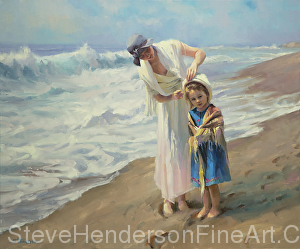
As children of God, we learn by imitation. The best parents are patient with their children’s attempts. Into the Surf, art print at Steve Henderson Collections
But no one has yet come up with a good answer.
As sons and daughters of God, however, perhaps we can, like Job, dispense with the constant flagellation of ourselves, the insidious worry that we are disgusting to God, the gnawing doubt that He could possibly accept us as we are right now, and still love us.
Instead of seeking, searching, wondering, guessing, probing, and agonizing over what we’re doing wrong — something that a judgmental God won’t tell us, apparently, even though we ask — maybe we can rest in His unconditional love for us, and take our chronic and aching problems straight into the room with Him.
“I hurt,” we say, much as a toddler brings to us their scratched finger, an older child their feelings about not being invited to a party, a teenager their humiliation at backing the car into the garbage can. When we are free of the fear that God’s default response will be reprisal and fury, we enter then into the true comfort of God, resting securely in our position as His beloved children, able to lean on the strength, wisdom, and compassion that are His.
Thank You
Thank you for joining me at This Woman Writes, where I explore the things we are told and taught about Christianity.
Posts complementing this one are
The Walt Disney World of American Christianity


















 This Woman Writes by Carolyn Henderson