“Why Do You Keep Doing Things That Hurt You?”

It’s amazing how often we don’t listen to our friends and family who have some fairly intelligent things to say.

White on White inspirational original oil painting of flowers in a vase in neutral setting by Steve Henderson

Our inner self is like a flower — beautiful, resilient, yet vulnerable to being bruised. Human beings need to be treated with gentleness. White on White, original oil painting by Steve Henderson.

(The inverse of this is that we pay undue attention to others who frequently don’t care about us at all or actively dislike us. We embrace their barbs, close to the heart where they scratch, and define ourselves by the opinions of disinterested strangers or active enemies. Don’t believe me? Talk to someone from middle school for ten minutes and see whose opinions have the most effect upon their self-worth.)

I’ll never forget the conversation we had with a family friend, who was visiting as a house guest for a few days. We were regaling her with what we thought at the time were amusing stories about the church we were then attending — or, not attending, because its actions were irritating us to the point that we enjoyed our time away far more than we did our penance in the pews.

“Why do you keep going? What are you getting out of it?” she asked. “This sounds like an abusive situation.”

That word “abusive” stopped us short, and we exerted ourselves to explain that while, yes, the leadership was controlling and distant, and no, we really didn’t feel of any value in the congregation, it wasn’t abusive, really. Actually, it was probably our lack of charitable thought that made us overreact. We should be more patient.

“Maybe so,” she replied with a smile, “but going there doesn’t seem to make you very happy.”

Her words stayed with us long after the visit, encompassing an increasing number of Sundays when we found something else to do with our time, but still interspersed with sporadic church attendance because, you see, we Christians define our spirituality by that church attendance.

(This is not untoward. The Barna Group, which describes itself as “the leading research organization focused on the intersection of faith and culture,” defined a practicing Christian, for poll purposes, as one who attends church at least once a month and says that his or her religion is very important in their lives.)

“If you really love God,” we’re told, “you’ll want to be with God’s people.

“And no church is perfect.

“We show the world that we love God by being patient with the things we don’t like, and not hyperfocusing on them. It’s not all about you, you know. We are a community.

“You need to give more in your spirit — flex and obey!”

There. Did I cover it all?

As time went by, and the little irritating quirks — increasingly introduced by a leadership team focused upon corporate growth philosophy and methods — kept piling on, we heard our friend’s question over and over:

“Why do you keep going? What are you getting out of it?”

And the answers that made the most sense were,

“We don’t know,”

and,

“Very little.”

And increasingly, we stayed away.

Our leisurely Sunday morning breakfasts replaced the hurried fellowship before the song worship service; random evenings with friends fulfilled our aching need to laugh and love and interact; long walks and discussion stimulated intellectual and spiritual thought; reading Scripture for ourselves — and debating it over the dinner table — sharpened our swords.

We found, to our surprise and quite without any intention, that we had replaced a bad situation for a good, and we were happy with what we were doing.

And we also found, not at all to our surprise, that many people who were not our friends and had no personal interest in our lives or family, were irritated by this, and called into question our Christianity because we no longer participated in what, for us, didn’t work.

“Dear children, let us not love with words or tongue but with actions and in truth,” 1 John 3:18 tells us, and for the first time in a long time, this was making sense, because we were interacting with humans — those who called Christ their brother as well as those who didn’t — and had time to love and laugh and argue and listen.

I think it’s called fellowship.

“This then is how we know that we belong to the truth, and how we set our hearts at rest in his presence whenever our hearts condemn us.”

No longer did we accept the subtle, and not so subtle, condemnation of a narrow way of looking at things, a way that begins and ends its definition of a person’s spirituality by easily defined outward actions.

We answered two questions, ones that we were asking within our hearts for a long time, but never admitted, outwardly, to having until a family friend — who DID care about us as people — asked them:

“Why do you keep going? What do you get out of it?”

To read more on this topic, please follow the link to my Commonsense Christianity article at BeliefNet, Abusive Christianity.


The Misfit Christian Book by Carolyn Henderson at amazon.com Live Happily on Less book by Carolyn Henderson at amazon.com Grammar Despair paperback and digital book at Amazon.com by Carolyn Henderson Step by Step Watercolor Success digital DVD workshop by Steve Henderson at Amazon.com

This article is linked to Imparting GraceI Choose JoyMisadventuresWoman to WomanSoul SurvivalWholehearted HomeIntentionMy Joy Filled Life, A Little R and RGive Me GraceGrowing in GraceThe Life of Jennifer DawnMoms the WordHomemakingTime Warp WifeWise WomanRoses of InspirationWednesday LinkSo Much at Home, Thriving on ThursdaysHomemaking ArtEmbracingChristian Mom BloggerLook at the BookSimple MomentsMissional WomanRebeccaArabah JoyFriendship FridaySincerely Paula

Posted in Art, blogging, church, Culture, Daily Life, decor, devotional, Encouragement, Faith, Family, fine art, home, inspirational, Life, Lifestyle, Relationships, religion, self-improvement, spirituality | Tagged , , , , | 6 Comments

Just How Equal Are We in Our Society?

I live in a theoretically egalitarian society.

I say theoretically because, although the Declaration of Independence which we, in my country, purport to honor, accept, and abide by (along with the Constitution of the United States) avers that “all men are created equal,” there’s difficulty in the very wording at the beginning:

Evening Waltz inspirational original oil painting of young couple dancing on ocean beach by Steve Henderson licensed prints at Framed Canvas Art and amazon.com

Life is a dance, and we do it most gracefully when we honor all those who dance it with us. Evening Waltz, original oil painting by Steve Henderson; licensed prints at Framed Canvas Art and Amazon.

Even Thomas Jefferson, in his forthright way, didn’t accept that women, or people of color, or non-land-owners fit into this “equal status.” Nowadays, of course, we hem and haw and say how things have changed and congratulate ourselves on being so much more advanced in a societally evolutionary state, but we, too, operate under our own set of peculiar standards and filter people through a sieve of our own making.

Every day, no matter how culturally sensitive we assure ourselves of being, we look at others and make judgments on how hard they work, by what kind of car they drive; or how intelligent they are, by the title of their job; or how worthy they are of existing at all, by whether or not they happen to reside inside a woman’s womb.

One way or another, we have a lamentable tendency of categorizing other human beings, assigning a mental value number to their lives, and justifying, all to frequently, a subtly different way of treating them based upon their income, education, appearance, or groups to which they belong.

“Well of course the President of the United States, or a Congressman, deserves our respect!” we are told.

Of course they do — and so does the woman who waitresses their table, or the man who mows their lawn, but for some reason we’re not expected to snap to attention when either one of those people walk into the room.

“My brothers, as believers in our glorious Lord Jesus Christ, don’t show favoritism,” James says in the book by his name, 2:1. He goes on to explain:

“Suppose a man comes into your meeting wearing a gold ring and fine clothes, and a poor man in shabby clothes also comes in. If you show special attention to the man wearing fine clothes and say, ‘Here’s a good seat for you,’ but say to the poor man, ‘You stand there” or ‘Sit on the floor by my feet,’ have you not discriminated among yourselves and become judges with evil thoughts?”

You bet we have, and we do it all the time. But such is the way of the world, and that is the point: in the world of men, the value of a man — or a woman, or a child, born or unborn — is significantly related to how much money he makes, how much power she holds, and how readily one recognizes his or her name, and for those who score high in these three areas, there is much glory and honor to be received from other men.

“But you are not to be like that,” Christ tells his disciples — us — in Luke 22:26. “Instead, the greatest among you should be like the youngest, and the one who rules like the one who serves.”

Our value, as humans, is not what we do, how much we make doing it, or whom we know, but rather, in who we are. And who we are, when we are Christians, are sons and daughters of God. There is no higher title than this.

God, unlike man, shows no favoritism, something Christians really need to get through our heads because there is a pervasive, and perverse, tendency to believe that we quite reasonably have what we have because we are so righteous, and thereby blessed by God. (Have you ever heard that tiresome dictum, “The U.S. has been blessed by God because it is a Christian nation?”)

While it is true that there are many promises blessing the man or woman who fears the Lord, and prosperity advocates point loudly to verses like Psalm 112:3 — “Wealth and riches are in his house, and his righteousness endures forever,”

we would do well to remember that truth is three-dimensional, and as Jesus’s Sermon on the Mount addresses in Matthew 5, God’s ideas of blessings do not incontrovertibly include money. Jesus singles out the poor in spirit, mourners, the meek, those who seek God, the merciful, the pure in heart, peacemakers and the persecuted and He calls them blessed.

Quite frankly, these blessed people do not resemble  the smug, self-satisfied, opulent “successful” people who attribute their lifestyle to their superior sense of Christianity. Some of these people have had the effrontery to look down upon their brothers and sisters of more humble station, and attribute that poverty to laziness, sleeping in too late, watching the wrong movies, and just a general sense of being “wrong.”

“If they were truly following God,” they sniff, “they would be where I am.”

I’m not sure that’s such a good place to be.

Where we are, and where we find our value as human beings, is in our position as God’s children, no longer slaves (or undervalued employees), but sons or daughters; and within that position, heirs with our Eldest Brother, Jesus Christ. (Galatians 4:7)

To read more on this topic, please follow the link to my Commonsense Christianity article at BeliefNet, Are You Ashamed of Your Job Title?

The Misfit Christian Book by Carolyn Henderson at amazon.com Live Happily on Less book by Carolyn Henderson at amazon.com Grammar Despair paperback and digital book at Amazon.com by Carolyn Henderson Step by Step Watercolor Success digital DVD workshop by Steve Henderson at Amazon.com

This article is linked to Imparting Grace, I Choose Joy, Misadventures, Woman to Woman, Soul Survival, Wholehearted Home, Intention, My Joy Filled Life, Shine, A Little R and R, Give Me Grace, Growing in Grace, The Life of Jennifer Dawn, Moms the Word, Homemaking. Time Warp Wife, Wise Woman, Roses of Inspiration, Wednesday Link, So Much at Home, Homeacre Hop, Thriving on Thursdays, Homemaking Art, Embracing, Christian Mom Blogger, Look at the Book, Simple Moments, Missional Woman, Rebecca, Arabah Joy, Friendship Friday, Sincerely Paula



Posted in Art, blogging, Business, Christian, Culture, Current Events, Daily Life, devotional, Encouragement, Faith, Family, fine art, home, inspirational, Life, Lifestyle, money, painting, Relationships, religion, simple living, spirituality, Work | Tagged , , , , | 10 Comments

What Does “Correct Doctrine” Look Like?

Wait for it.

If you’re a Christian asking questions and, not satisfied with the answers you’re being given, you start reading the Bible for yourself to see if what you’re being taught is true, it won’t take long before someone grabs you and says,

The New Hat inspirational original oil painting of 1940s nostalgic woman in Victorian home by Steve Henderson

Correct Doctrine does not necessarily look like something we see in the mirror. It is reflected in God. The New Hat, original oil painting by Steve Henderson

“You must stop being a rebel. If you stray from the teaching and direction of leadership, you’re in danger of losing correct doctrine.”

Correct doctrine — it’s the whip swung over the head of anyone who gets too far out of line, but rarely is the question asked,

“Just what, exactly, is correct doctrine?”

If it is the statement of faith made by one’s particular denomination, then this quickly becomes a problem, because even in the most general of statements, there is variance, and that’s among denominations that sort of, technically, agree. If a group of people from 15 different church entities took the gloves off and stated, baldly, correct doctrine from their standpoint, we would rapidly see the doughnuts and cheap coffee fly:

  • Do we speak in tongues, or not?
  • Is the communion bread Christ’s actual body, or just symbolic of it?
  • Is the Sabbath on Sunday, or Saturday?
  • Is salvation permanent, or can it be lost?
  • Are people chosen, incontrovertibly, to be saved or damned, or do they have a say in this?
  • Must one utter actual specific words to be saved, or is it possible for someone to experience grace without them?
  • If one is of Hebrew descent, does one receive a free “get out of hell” free card simply for one’s ancestors being such a significant part of the Old Testament?

These are all fairly weighty issues, many of them an essential part of one group or another’s correct doctrine and vehemently defended by the experts, teachers, and leaders of that particular faith party.  It quickly becomes obvious that if one ascribes to the “correct” answers of one denomination, one is in violation of the “right doctrine” of another.

So, perhaps “correct doctrine” is not so rigidly construed. Nor is it guaranteed that attending church is a mandatory element of finding it.

“Preach the Word,” Paul tells Timothy in 2 Timothy 4:2-4. “Be prepared in season and out of season; correct, rebuke and encourage — with great patience and careful instruction.”

Here’s the kicker:

“For the time will come when men will not put up with sound doctrine. Instead, to suit their own desires, they will gather around them a great number of teachers to say what their itching ears want to hear.”

(Interestingly, my Greek interlinear Bible translates “sound doctrine” as “healthy teaching.” This gives a different twist to the verse, one not quite so tightly wound.)

Many of us can conjure up  an instant mental list of “ministries” that fall into Paul’s description, and they don’t necessarily look, or act, like weird, flaky cults. These latter are (relatively) easy to identify; more difficult is pinning down precious points of precept that sound good, and are hammered in as truth, but are a little hazy in their verity. A good lie is one blended smoothly with a lot of truth (for an example, look at the subtle difference in wording between Satan’s question to Eve in Genesis 3:1 and God’s actual words in 2:16).

So what do our “itching ears want to hear”?

That we can all be rich, that every prayer we pray should be answered if we force God to do so by certain secret words, that our positive attitude affects our physical reality — that, in short, we can be as gods.

I’m pretty sure that this is not what Paul means by “correct doctrine.” Or healthy teaching.

Or how about this, a bit harsher:

That we must submit to every authority — secular or religious — because God demands it, that God is so focused on our sinful nature that He is repulsed by us, that we must prove our love and faith to Him first before He will love us, that He rejects people “living in sin” and wants nothing, at all, to do with them.

John chapters 14, 15, 16, and 17 record many of Jesus’s words which should encourage us that we can, and He wants us to, have a secure, loving relationship with our Father the way He does.

Indeed, if we are concerned about correct doctrine, or better yet, healthy teaching, we can start in no better place than this: that God is trustworthy, truthful, loving, gracious, kind, and desiring to have a close, intimate relationship with us.

And to learn more about this, we need nothing more than time with our Father: time reading His words, time reflecting upon His goodness, time getting it firmly through our heads that He is light with no darkness in Him at all, and He never acts in a random, irritable, unfair, demeaning, thoughtless manner — the type of behavior we too frequently experience, and come to expect, from men.

To read more upon this topic, please follow the link to my Commonsense Christianity article at BeliefNet, Not a Leader? Good! God Can Talk to You.

The Misfit Christian Book by Carolyn Henderson at amazon.com Live Happily on Less book by Carolyn Henderson at amazon.com Grammar Despair paperback and digital book at Amazon.com by Carolyn Henderson Step by Step Watercolor Success digital DVD workshop by Steve Henderson at Amazon.com

This article is linked to Woman to WomanImparting GraceI Choose JoyWholehearted HomeIntentionSoul SurvivalMom to MomHearts from HomeTell It TuesdayA Little R and RGrowing in GraceJennifer DawnRaising HomemakersWise WomanMoms the WordTitus 2sdayChristian Mom BloggerLook at the BookSimple MomentsMissional WomanRebeccaArabahFriendship FridayMisadventure,


Posted in Art, blogging, Christian, church, Culture, Daily Life, devotional, Faith, Family, fine art, home, inspirational, Life, Lifestyle, painting, religion, spirituality | Tagged , , , , , | 3 Comments

Three Questions to Ask about Modern-Day Apostles

We humans are always looking for the next rock-star, or celebrity actor, or anybody with an aura about them that makes us want to join the fan club.

Wild Child inspirational original oil painting of little girl running by Victorian house near ocean coast by Steve Henderson licensed prints at Great Big Canvas, icanvas, Framed Canvas Art, allposters.com, art.com, and amazon.com

We are children of God, and regardless of what work we do for our Father, we maintain the heart and humility of a child. Wild Child, original oil painting by Steve Henderson; licensed prints at Allposters.com, amazon.com, art.com, Framed Canvas Art, iCanvas, and Great Big Canvas

Quite unfortunately, it differs little in contemporary Christian circles, and while too many moms of tweens are fooled by the day’s current Sweet Christian Singing Thing who radically changes upon turning 18, this post has to do with self-described, self-imposed, modern-day apostles, prophets, and teachers — many of whom put high pressure on their followers for funding because, they say, they have been called to do the mighty work of God, and listeners are obligated to obey God with their debit cards and checkbooks.

How do you resist an offer like that? “If you don’t fund me, people will die in their sins, and you will be to blame.”

Well, let’s look at three questions we can ask ourselves before we pay to play:

1) Is this person true?

“Watch out for false prophets,” Jesus tells us in Matthew 7:15. Peter, a true apostle, describes false teachers as those who “secretly introduce destructive heresies, even denying the sovereign Lord . . . In their greed these teachers will exploit you with stories they have made up.”

False teachers are out to make money. Some of them, as part of their program, perform high level magic tricks, or close their eyes and intone highly generalized prophetic statements that fit as accurately as today’s horoscope. If the person claiming your attention and funds enjoys a lifestyle much greater than the average person sending him checks, it’s worth stopping to think.

And if he claims to heal or perform miracles of any sort, it’s extra worth stopping to make sure that these claims are true. The words on his website, or those run by corporations he owns, aren’t the best resource.

2) Whose name does this person promote?

True teachers, like Christ, point their message, always, back to God, and away from them. There is a sense of humility about a true follower of God that gives real meaning to Christ’s injunction to not seek the honor of men (Matthew 6:2)

“I do not accept praise from men, but I know you. I know that you do not have the love of God in your hearts,” Jesus told the Jewish religious leaders who persecuted Him in Matthew 5:41.

“How can you believe if you accept praise from one another, yet make no effort to obtain the praise that come from the only God?”

One of the most useful litmus tests I’ve found regarding the genuineness of a speaker has to do with the size and scope of their name on publications associated with them. For example, when the name on the book is more prominent than the title, I generally give it a pass. The same goes for a business: when the name of the leader outshines its purpose, I’m skeptical.

It’s also worth not getting excited about family names. While Deuteronomy 7:9 assures that God keeps his covenant of love to a thousand generations of those who love him and keep his commands, this is no promise of an earthly kingship of ministerial speakers who step, from father to son to grandson, into place, as if they were heirs to the throne.

When it comes to that, 1 and 2 Kings and 1 and 2 Chronicles record a number of sons who do, or don’t, follow in the footsteps of their fathers. Christianity is not an inherited birthright.

3) Is this person humble?

All Christians are called to follow the example of our Eldest Brother , who came “down from heaven not to do my will but to do the will of him who sent me.” (John 6:39)

Or as Paul phrased it in Philippians 2:6-7,

“Being in very nature God, (he) did not consider equality with God something to be grasped, but made himself nothing, taking the very nature of a servant.”

Jesus did not raise His hands and bask in the accolades of his audience, nor did He define Himself by associating, prominently, with high-ranking men of the world. He didn’t own a private jet, and He intimately interacted with as many, and probably considerably more, regular, ordinary people.

Jesus built no walls — literal or figurative — around Himself.

These three questions are a starting point, and while they may or may not work for you, the concept behind them — that we do not intrinsically believe what we are told but, like the Bereans of Acts 17, examine the Scriptures to see what we are told is true — is sound.

For more on this subject, please follow the link to my Commonsense Christianity article at BeliefNet, Modern Day Apostles.

The Misfit Christian Book by Carolyn Henderson at amazon.com Live Happily on Less book by Carolyn Henderson at amazon.com Grammar Despair paperback and digital book at Amazon.com by Carolyn Henderson Step by Step Watercolor Success digital DVD workshop by Steve Henderson at Amazon.com

This article is linked to Woman to Woman, Imparting Grace, I Choose Joy, Wholehearted Home, Intention, Soul Survival, Mom to Mom, Grace, Hearts from Home, Tell It Tuesday, Shine, A Little R and R, Growing in Grace, Jennifer Dawn, Raising Homemakers, Wise Woman, Moms the Word, Titus 2sday, Christian Mom Blogger, Look at the Book, Simple Moments, Missional Woman, Rebecca, Arabah, Friendship Friday, Misadventure,


Posted in Art, blogging, Christian, church, Culture, Current Events, Daily Life, decor, devotional, Encouragement, Faith, Family, fine art, home, inspirational, Life, Lifestyle, painting, religion | Tagged , , , , , , | 2 Comments

How the Corporate World Infects Christianity

Excellence.

It’s an intriguing word, one that I, personally, never associate with Christianity, nor my walk with God.

The world of business may not be the best place to look for the language of unconditional love. New York Skyline, circa 1920, AP photo.

The world of business may not be the best place to look for the language of unconditional love. New York Skyline, circa 1920, AP photo.

Humility, grace, mercy, love, patience, Fatherhood — these words roll gently off the tongue and into the heart, inspiring me daily to seek the good gifts from my Eldest Brother’s hands. Like all humans, I long for, ache for, yearn to experience unconditional love and acceptance. I desire confidence in the presence of my God that I mean something to Him, and that He embraces me into His household as His dearly beloved daughter.

Learning that this is so — well, that is good news indeed.

Simple, basic words — like love, acceptance, friendship — are akin to a good soup, nourishing and uncomplicated, delicious in their simplicity, healing in their warmth.

Unfortunately, however, within contemporary Christianity, simple words, like the profound, but deeply simple, concepts that they describe, are readily exchanged for the frigid, emotionless, coldly practical terms networked about in the corporate business environment: intentionality, excellence, ownership, community, purpose, drive, even passion seems passionless in the way it is used: “I pursue, with excellence, the passionate intention to glorify God’s power and might within the vibrant community of his purposeful people!”

Whatever that means.

The words themselves are meaningless, distant from human emotion or content, but we use them because they sound forceful and bold, the way a successful CEO would sound. And given that the average successful CEO is that way not because he, or in fewer cases, she, is kind, thoughtful, warm, caring, funny, endearing, merciful, just, and loving, it’s odd that we would choose to mimic the same language within an environment — church culture — that is supposed to embrace those nine aforementioned qualities.

God is love, not intention; He seeks a meaningful relationship with His children, not purposeful interaction; He teaches us to be humble, not excellent.

But in our fascination for corporate culture, and our willingness to embrace not only its terminology, but its belief system, into our place of worship, we abandon the true excellence of God — His love for us, His majestic power, His unending grace, His very own humility shown in the person of His Son — and pressure ourselves to achieve an excellence of our own.

We are to be excellent in our prayer life, which, I guess, means that we get pretty much everything we ask for — that’s success, isn’t it?

And speaking of success, we are to be excellent in our financial affairs because, when God is pleased with someone He blesses them, and the outward manifestation of that approval, indeed, is that we are wealthy. It’s too bad about all those millions of starving people. They really should get to know God.

We are to be excellent in how we speak, how we dress, how we come across to others — poised, confident, strong, immovable. Our excellence is to be of such a degree that all those around us stop, in awe, and breathe, “That person. He is so excellent.”

“For I desire mercy, not sacrifice, and acknowledgement of God rather than burnt offerings,” God says in Hosea 6:6.

It is not what we do, but who we are that matters before God. And when we are proud, and put together, and forceful, dogmatic, overbearing and self-assured — convinced of our excellence — then we are in very real danger of walking away from the better person whom God is constantly trying to shape us to be: humble, meek, dependent upon our Father and listening to Him, eager to walk beside Him and simply bask in the beauty of His presence.

We are not doormats — we are children of God: confident in His love, trusting in His faithfulness, and delighting in His — God’s — excellence.

Are you tired of corporate terminology infecting spiritual wisdom? Please read more on this topic at my Commonsense Christianity article at BeliefNet, Does God Care If We Are “Excellent”?

The Misfit Christian Book by Carolyn Henderson at amazon.com Live Happily on Less book by Carolyn Henderson at amazon.com Grammar Despair paperback and digital book at Amazon.com by Carolyn Henderson

This post is linked to Woman to Woman, Wholehearted Home, Intention, Embracing, I Choose Joy, Imparting Grace, Soul Survival, Mom to Mom, Tell It Thursday, Hearts for Home, Give Me Grace, Shine, A Little R and R, Growing in Grace, A Little Bird, Homemaking, Wise Woman, Time Warp Wife, Titus Tuesdays, Simple Life, Moms the WordSimple MomentsLook at the BookMissional WomanChristian Mom BloggerRebeccaArabahCreate with JoyMisadventuresFellowship Friday

Posted in Art, blogging, Business, Christian, church, Culture, Current Events, Daily Life, devotional, Encouragement, Faith, Family, home, inspirational, Life, Lifestyle, religion, spirituality | Tagged , , , , | 13 Comments

Other Humans Are Not Our Servants

It is a universal truth that people who like the Jane Austen book, Pride and Prejudice, frequently go beyond mere “like” to excessive admiration. One of my own daughters is just such a fan, revisiting the story in book, movie, or mini-series form on a regular basis.

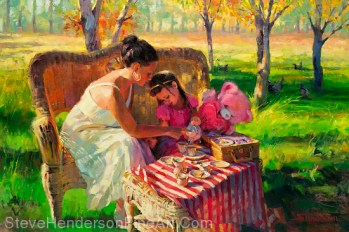
Afternoon Tea inspirational original oil painting of mother and child at tea party in meadow by Steve Henderson; licensed prints at Great Big Canvas, iCanvas, Framed Canvas Art, amazon.com, art.com, and allposters

How we treat others who are more vulnerable than we — especially when others are not watching — says more about who we are than any job title we hold. Afternoon Tea , original oil painting by Steve Henderson; licensed prints at art.com, amazon, allposters, Great Big Canvas, iCanvas, and Framed Canvas Art

“Life was so much better in those days,” she says with a sigh during those moments when modern life seems especially dislikable.

“Only if you were born to the right station in life,” I reply. “And even then, you still had to use chamber pots. Which, I suppose, is better than being the person who had to empty them.”

Because, you know, in any society, no matter how free, there is the person who empties the chamber pots. While today with modern plumbing this particular task is no longer so necessary, there is never a dearth of jobs that nobody wants to do. But there are many such jobs that need to be done.

My parents were of the generation that said, “An honest job, done well, is nothing to be ashamed of. Putting food on the table for one’s family is the most honorable thing that can be done.”

It’s a good attitude, one that is worth having whenever any of us finds ourselves in a position, literally, of humility, vulnerability, and social censure simply because of the job title we hold. In a society that defines ourselves, and our worth, by the work we do to earn money so that we can eat, it is easy to judge our worth, as humans, by man’s standards:

Are we a doctor, a lawyer, a politician, a university professor, an expert of some sort?

These are good things, we are taught, and anyone who does them is successful, regardless of the content, if any, of their character.

But as Christians, our world view is not shaped by the doctrines of men, and the apostle James says in the book that bears his name,

“My brothers, as believers in our glorious Lord Jesus Christ, don’t show favoritism.

“If you show special attention to the man wearing fine clothes and say, ‘Here’s a good seat for you,” but say to the poor man, ‘You stand there,’ or “Sit on the floor by my feet,’ have you not discriminated among yourselves and become judges with evil thoughts?” (2:1, 3)

It’s a pertinent question, and one many of us would automatically answer,

“Of course I treat all my brothers and sisters in Christ with respect!”

But the proof of how true our answer is lies in how we truly do treat others, and one of the best evidences of this is at the grocery store, when we are purchasing our groceries.

“Hello, how are you?” the grocery clerk greeted the woman behind me as I was picking up my bags and heading on my way.

The woman looked at her, looked away, and didn’t answer.

Now while it may be that she had hearing problems and didn’t hear the question, the issue of customers not greeting back the clerks who sell them their groceries is not an unusual one, something I know from personal experience, as well as the experience of those who are presently behind the retail lines.

“People talk on phones, they talk to each other, or they simply say nothing at all,” one person in the front lines, behind the register, told me. “Some people are very nice, but a disturbing number act rudely, as if we were their servants or something.”

“You, stand there,” or “Sit on the floor by my feet.”

An attitude of entitlement, at the expense of other human beings, or looking over someone’s head as if they didn’t exist, is not the attitude toward which we, as believers, have been called, and while I would like to believe that no Christian treats another human being, ever, like a lesser creature, I know this isn’t true.

We are not perfect. We all have bad days, and on some of them, unfortunately, we are not at our friendliest in public. But when it is an attitude of mind, a belief that the people who serve us, in public, are by some extension our actual servants and are thereby treated as such, then we are definitely acting at variance with the teachings of Christ, who tells us,

“I have set you an example that you should do as I have done for you.

“I tell you the truth, no servant is greater than his master, nor is a messenger greater than the one who sent him. Now that you know these things, you will be blessed if you do them.” (John 13:15-17)

Our Master, our Eldest Brother, set us an example of humility, meekness, and respect toward other human beings. As servants of Him, and more importantly as younger brothers and sisters in the household of His and our Father, we can do no better than to follow this example.

To read more on this subject, please follow the link to my Commonsense Christianity article at BeliefNet, Do We Treat Fellow Christians Like Servants?

The Misfit Christian Book by Carolyn Henderson at amazon.com Live Happily on Less book by Carolyn Henderson at amazon.com Grammar Despair paperback and digital book at Amazon.com by Carolyn Henderson Step by Step Watercolor Success digital DVD workshop by Steve Henderson at Amazon.com

This post is linked to Woman to WomanWholehearted HomeIntentionEmbracingI Choose JoyImparting GraceSoul SurvivalMom to MomTell It ThursdayHearts for HomeGive Me GraceA Little R and RGrowing in GraceA Little BirdHomemakingWise WomanTime Warp WifeTitus TuesdaysSimple Life, Nourishing JoyMoms the Word, Simple Moments, Look at the Book, Missional Woman, Christian Mom Blogger, Rebecca, Arabah, Create with Joy, Misadventures, Fellowship Friday

Posted in Art, Christian, Culture, Current Events, Daily Life, devotional, Encouragement, Faith, Family, fine art, home, Job, Life, Lifestyle, painting, Personal, Relationships, religion, simple living, spirituality, Uncategorized, Work | Tagged , , , , | 15 Comments

What Brave Looks Like

We live in a world that worships movies.

And while many Christians would swear up and down that they worship nothing but God and have no idols, honest people stop and admit that popular mass media affects, generally in a non-positive way, how we see our lives and interpret ourselves.

Grace inspirational original oil painting of dancing woman in pink dress on ocean beach by Steve Henderson; licensed prints at Framed Canvas Art and Amazon.com

She doesn’t look like a warrior, does she? But most of life’s battles don’t happen where we think they do, and those who fight with grace, trust, hope, and faith, make it to the end. Grace, original oil painting by Steve Henderson; licensed prints at Framed Canvas Art and Amazon.

Three hundred years ago, people riding a horse across a meadow didn’t hear a soundtrack in their head.

Today, given the right mood and song on the radio, many of us driving to the grocery store for milk find ourselves, mentally, doing something else, something far grander and more adventurous than driving to the grocery store for milk.

And while a little daydreaming is harmless enough, when our thoughts revolve around an imaginary life and an imaginary world promoted and pushed by an entertainment industry that isn’t satisfied with our money, but wants to shape our world view as well, then a little daydreaming can turn into a lot of dissatisfaction with our actual, real life.

We want to be brave, we want to be adventurous, we want to be bold — we want to live a life with meaning and direction, and if we don’t watch ourselves, we fall into the trap of looking to the imaginary world of movies as the place to find this.

But the place to find meaning in our life is with the Creator of that life, and while that sounds remarkably trite and oh-so-Christian, it’s quite sensible, actually, far more sensible than defining ourselves by characters in a film, or worse yet, by the actors who pretend to be people they’re not when they play characters in a film.

“Therefore, put on the full armor of God, so that when the day of evil comes, you may be able to stand your ground, and after you have done everything to stand,” Paul tells us in Ephesians 6:13.

The imagery of this is very Middle-Earth-like, resembling the characters and story line of The Lord of the Rings series, and those of us who enjoy the movie (and yes, I loved, and still love, the books, first) are inspired and encouraged by the mighty acts of valor, performed within a stirring soundtrack and stunning cinematic detail, that even the smallest of Hobbits put forth in this film.

But it is easy to forget, from our position on the couch, that life, real life, doesn’t generally look this way, and even if it did, the ratio of exhilarating adventure on a physical battlefield to the ordinary tasks of life is small. Most of our lives are spent doing the ordinary things it takes to live that life — driving to work, doing whatever it is we do for work, preparing meals, washing dishes, emptying the garbage, swishing toilets.

These mundane, necessary jobs are not the stuff of epic movies (which is why we don’t see them happening in movies, unless the character is trying to show us what a regular, ordinary guy he is), but they are the stuff of life, and the bravest people are those who look least like characters in movies (or “reality” TV shows): the bravest people are those who roll out of bed to go to a job they abhor because they have people in the family to feed, who deal with chronic illness or pain and insist that it will not define who they are, who care for a loved one who will never get better and who other people are embarrassed to be seen with in public, who walk tall into a room where others have just been gossiping about them, who deny themselves a small treat because this month’s finances just won’t stretch that far and someone else needs new socks.

Bravery does not exclusively involve war scenes and military uniforms — indeed, most of the time it does not. Bravery involves getting up when we are knocked down, and continuing to walk.

“Be joyful in hope, patient in affliction, faithful in prayer. Share with God’s people who are in need. Practice hospitality,” Paul exhorts in Romans 12:13-16.

“Bless those who persecute you; bless and do not curse. Rejoice with those who rejoice, mourn with those who mourn. Live in harmony with one another.

“Do not be proud, but be willing to associate with people of low position. Do not be conceited.”

These are acts of bravery, but not the kind exalted in movies, and most of the time, they are not seen, or recognized, by crowds of adoring people. Our Father, however, who is in secret, sees our pain and struggling and determination and effort, and He walks with us as we walk. With Him at our side and in our hearts, we are brave.

To read more on this subject, please follow the link to my Commonsense Christianity article at BeliefNet, Are You a Brave Christian?

The Misfit Christian Book by Carolyn Henderson at amazon.com Live Happily on Less book by Carolyn Henderson at amazon.com Grammar Despair paperback and digital book at Amazon.com by Carolyn Henderson Step by Step Watercolor Success digital DVD workshop by Steve Henderson at Amazon.com

This post is linked to A Little R and R, Arabah JoyRebeccaChristian Mom BloggerCreate with Joy, 3D Lessonshearts for homeTell It TuesdaysMissional WomanMom to MomSoul SurvivalI choose joyEmbracingImparting GraceLook at the BookSimple MomentsIntentionWholehearted HomeWoman to Woman

Posted in Art, blogging, Christian, Culture, Current Events, Daily Life, devotional, Encouragement, Faith, Family, fine art, home, inspirational, Life, Lifestyle, mass media, media, movies, painting, Random, religion, self-improvement, spirituality | Tagged , , , , | 3 Comments

Dear God: Why Is Nothing Happening?

It’s not peculiar that we humans are reassured by knowing we’re not the only ones going through something. The Internet –in which people are able, at least for now, to express themselves beyond writing a newspaper Letter to the Editor — has done much in recent years to encourage people who otherwise have thought that they were weird.

Purple Iris inspirational original watercolor of flower by steve henderson, licensed prints at framed canvas art

Growth is not something that happens quickly, and though nothing seems to be happening, the seed germinates, the plant bursts through, the flower blooms. Purple Iris, art print from Steve Henderson Collection.

We’re not weird — other people have questions, doubts, misgivings, and concerns about all sorts of other things — our government, our educational institutions, our medical establishment, our judicial system,  our coldly calculating corporate society, and, certainly not least, our religious arena. (Regarding the latter, it is because people are able to readily and ably connect with others who propound similar questions that we are seeing a distinct exodus from the systematized, syndicated church establishment. Many of the people leaving are committed Christians who are waking up, realizing that the dissatisfaction they are feeling is not necessarily because they are difficult, obstreperous, and spiritually cold.)

Within our walk as Christians, it is easy to get the sense that we are alone in our problems, and when deep, aching prayers appear to go unanswered and unheard, we blame ourselves because, well, those around us do:

“You don’t have enough faith,” is the frequent observation, so tiresomely predictable that we should make T-shirts out of it and pass them out to all the Christians in our lives.

“We’re not honest with ourselves,” would be a better slogan, not one to further castigate us for our lack of perfection, but to free us from the misconception that good, successful Christians never cry out, never get frustrated, never despair, and always get what they ask for from God because He is pleased with them. Such is the foundation upon which the Prosperity Doctrine is built, but the worship of money, and power, seeps into all our lives, and even when we think we’re not pursuing a lie, we spend a lot of time focusing on it.

“You hem me in — behind and before; you have laid your hand upon me,” the Psalmist says in 139:5. This is not a declaration or claim or announcement of mighty faith as it is an observation — quite realistically born out of frustration — that the writer’s movements are severely circumscribed. If we put it into the common tongue — “God. Nothing is happening. I’m not going anywhere” — we would immediately be admonished,

“That’s negative speaking. If you talk that way, how can you expect God to answer your prayers?”

“Hear my prayer, O Lord, listen to my cry for help: be not deaf to my weeping,” Psalm 39:12 says, with the implication that the prayer has been uttered more than once, and the person praying it feels that it has not been heard. “Why, O Lord, do you reject me and hide your face from me?” Psalm 88:14 is candidly direct.

Isaiah 38:11-14 gives a series of visual images — “No longer will I look on mankind or be with those who now dwell in this world . . Like a weaver I have rolled up my life and he has cut me off from the loom . . . day and night you made an end of me” — that can, and should encourage us that even those whom we think the most godly experience discouragement, and a loss of confidence in the only Person who can help them.

And what about the great prophet Elijah, who in 1 Kings 19 is so overwhelmed by the threats of Jezebel and the evil of the Israelite community, that he prayed,

“I have had enough, Lord. Take my life; I am no better than my ancestors.”

None of this is positive talk, and therefore, by 21st century establishment Christianity standards, should not be expressed — and it frequently isn’t because we’re smart enough to read a room, not requiring much time with the group before we figure out that this kind of talk makes others uncomfortable. Honesty generally does.

And honesty is what God wants from His children. It is what is expressed in the Psalms, it is brutally exposed in the very history recorded in the Bible — even the Greats, the ones whose names we know, experienced fear, doubt, anxiety, worry, discomfiture and dismay.

The exhibition of these very human emotions did not result in God throwing up His hands in frustration and storming out of the room, and He will not do so with us, His children who are free to come to Him in all honesty, vulnerability, and need. We are not alone in our frustration, doubt, impatience, anxiety, and urgent desire that God do something, NOW, and we do not need to let the fear of this stop us from going, with confidence, to the Only Person who can take all that garbage, toss it to the side, and help us.

The Misfit Christian Book by Carolyn Henderson at amazon.com Live Happily on Less book by Carolyn Henderson at amazon.com Grammar Despair paperback and digital book at Amazon.com by Carolyn Henderson

This article is linked to The Deliberate Mom. A Little R and R, Arabah Joy, Rebecca, Christian Mom Blogger, Create with Joy, 3D Lessons, hearts for home, Tell It Tuesdays, Missional Woman, Mom to Mom, Soul Survival, I choose joy, Embracing, Imparting Grace, Look at the Book, Simple Moments, Intention, Wholehearted Home, Woman to Woman


Posted in Art, blogging, Christian, church, Culture, Current Events, Daily Life, decor, devotional, Faith, Family, fine art, floral, home, inspirational, Life, Lifestyle, prayer, religion, spirituality | Tagged , , , , | 9 Comments

Breathing the Same Air as God

In our latter days of church attendance, we encountered the Michael W. Smith song, “Breathe,” in which the lyrics state,

“This is the air I breathe.

“This is the air I breathe.

“Your holy presence living in me.”

The Land of Chief Joseph by Steve Henderson

When we think of where God is, we often think of the cosmos, or the mountains, because these are majestic places. But one of the places where He is, is within us, His holy spirit dwelling with our soul. The Land of Chief Joseph, original oil painting by Steve Henderson.

The chorus says,

“And I am desperate for you.

“And I am lost without you.”

The words, set to a haunting melody, impacted me, and in the time subsequent I have often stopped to observe my breathing, with each respiration thinking, “You and I, Father, are sharing the same breath. And I only take that breath because you give it to me.”

In Genesis 2:7 we are told,

“The Lord God formed the man from the dust of the ground and breathed into his nostrils the breath of life, and the man became a living being.”

Now I have read this verse many times, generally in conjunction with the children’s AWANA program, when my central focus was to get some very young child to the point that he or she could repeat it, verbatim, without snickering over the word, “nostrils.”

I no longer care about this issue, and this last week when I encountered the verse I tried to read it as if it were for the first time, as opposed to the 63rd or 87th, and understand what it was saying:

Our very breath comes from God.

Inhale. And Exhale. And repeat. I don’t know how many times we breathe in a day or a month or a lifetime, but I do know that, not only do we do so most of the time without any conscious thought, but even when we do think about taking a breath, we can’t create it on our own. It is given to us, as a gift, from God, the giver of all life.

“O Lord, you have searched me and you know me,” Psalm 139 tells us.

“You know when I sit and when I rise; you perceive my thoughts from afar.

“You discern my going out and my lying down; you are familiar with all my ways.

“Before a word is on my tongue you know it completely, O Lord.”

Now when men focus upon our private lives — with their cameras, their hidden microphones, their software programs, their government agencies — it’s creepy. But when it comes to God, in whom there is no darkness at all (1 John 1:5), there is comfort in knowing that the creator of all things — me, and you, the sparrows that fall to the ground and the people we love — is aware, and cares about, our hurts, anxieties, joys, fears, hopes, dreams, and deep, deep, aching desires.

He is not off, preoccupied, in some distant quarter, unaware of us or incapable of keeping track of us amidst all the other people He has made. He is close — so close that we share the same breath — and our life is intertwined with Him, so intertwined that our very next breath is in His hands.

Please read more on this subject at my Commonsense Christianity article at BeliefNet, Without God, We’ve Got Ten Minutes, Tops.

The Misfit Christian Book by Carolyn Henderson at amazon.com Live Happily on Less book by Carolyn Henderson at amazon.com Grammar Despair paperback and digital book at Amazon.com by Carolyn Henderson Step by Step Watercolor Success digital DVD workshop by Steve Henderson at Amazon.com

This post is linked to A Little R and RArabah JoyRebeccaChristian Mom BloggerCreate with JoyHearts for HomeThought ProvokingTell It TuesdaysMy Joy-Filled LifeSoul SurvivalMotivateGood MorningA Look at the Boo

Posted in Art, Christian, church, Culture, Current Events, Daily Life, devotional, Faith, Family, Growth, home, Life, Lifestyle, painting, prayer, religion, spirituality, Uncategorized | Tagged , , , , , , | 6 Comments

Celebrate the Little Things of Life — The Evening Ahead

The story of the painting, The Evening Ahead, by Steve Henderson at Start Your Week with Steve.

There is a pleasurable sense of anticipation when we are preparing for a special evening or notable event. And the beauty of it all is that the event does not have to be gigantic, or momentous, to instill a sense of well being and joy.

The Evening Ahead inspirational original oil painting of fashionable vogue woman dressing her hair by Steve Henderson

Part of the pleasure of any outing is the anticipation and preparation beforehand. The Evening Ahead, original oil painting by Steve Henderson.

Indeed, because it is often the smallest things that bring the greatest impact, there is potential for great joy, given that life is full of many small things. We don’t have to wait to win the lottery to be happy; we simply plan an outing — whether it’s a picnic on the back porch or a chef’s table at a fine restaurant — and think gentle thoughts upon it as we prepare.

So it is in the painting, The Evening Ahead, fresh off the easel. Celebrating the simple joys of life, The Evening Ahead joins a beautiful woman in her boudoir (do we still use that term? It’s a grand way of thinking about the rooms in our house) as she prepares for a night on the town. She is relaxed and at peace, concentrating upon the sweep of her hair.

In the background, a mirror reflects a gauzy image back at the woman, a a figurative reflection of her soft, calm thoughts.

Soft, calm thoughts. These are good things to have, and any circumstance that promotes them is worth seeking and encouraging.

The Evening Ahead is an original oil painting on panel, 24 x 18. With the gold frame included with its purchase, it has a finished wall hanging size of 30 x 24.

The Misfit Christian Book by Carolyn Henderson at amazon.com Live Happily on Less book by Carolyn Henderson at amazon.com Grammar Despair paperback and digital book at Amazon.com by Carolyn Henderson Step by Step Watercolor Success digital DVD workshop by Steve Henderson at Amazon.com

Posted in Art, Beauty, blogging, Daily Life, decor, fashion, home, Life, Lifestyle, painting, Uncategorized | Tagged , , , , , , , | 2 Comments