What “Should” Your Child Be Reading?

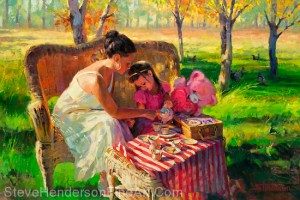
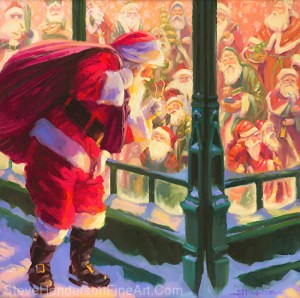
Reading opens up the world and the universe to us, from the time that we are very young children. Bold Innocence, original oil painting by Steve Henderson, sold; licensed, open edition print at Great Big Canvas.

I grew up in a household of books, and given that there were five kids and two parents with widely divergent interests — from molecular biology to Bobby Sherman, the singing heartthrob — there was no end of variety.

As the youngest child, I watched my siblings grow up and move away, but many of their books stayed behind. In my oldest brother’s room I discovered, and consumed, C.S. Lewis’ Narnia Chronicles. My sister’s Nancy Drew volumes filled many winter afternoons. There were science fiction, history, romance, fairy tales, western fare, and dusty tomes about insects, the colored plates separated by tissue paper.

There was even, hidden away amongst chemistry textbooks, a much thumbed copy of Everything You Always Wanted to Know about Sex but Were Afraid to Ask.

From High-Brow to Low Level

I read it all (and believe me, the sex book helped because my parents’ only contribution to elucidating the subject was a pamphlet about flowers, and while I learned something about pistils and stamens, I never did make the connection to human activity).

Reading takes us to all sorts of places — from the highest mountains to the deepest depths of the sea. The Land of Chief Joseph, original oil painting, 24 x 40, by Steve Henderson.

As I grew older, I explored Ivanhoe, The Good Earth, Brave New World, Animal Farm, Jane Eyre and the Vicar of Wakefield along with a whole series of cheap spy novels, thrillers, and books by an emerging author of pop horror. Nobody, ever, told me what I could and could not read.

With this background, it only made sense that when I had children of my own, I would set them loose in the household, free to explore whatever literature caught their fancy or their eye, and secure in knowing that, even if they found something about sex that didn’t reference flowers, they would be fine. Indeed, our second daughter’s not so covert — and eventually fulfilled — desire was to peruse her illustrator father’s photo reference book of the human body, which consisted of hundreds of shots of men, and women, in various poses and states of dress . . . and undress.

I can still see her face when she discovered — unknowing that her father and I were watching — a full frontal view of the human male. No pistils and stamens for this girl.

Different Kinds of “Bad”

While I knew that this relaxed attitude toward our children’s reading proclivities was fairly unusual, I had no idea quite how reprobate and degenerate we were in our parenting until I listened to some — fortunately not all — of the homeschooling and/or religious community around us. Not only did many of these parents keep a tight eye on what the little eyes of their little charges saw, they actively chose what their children were allowed to read.

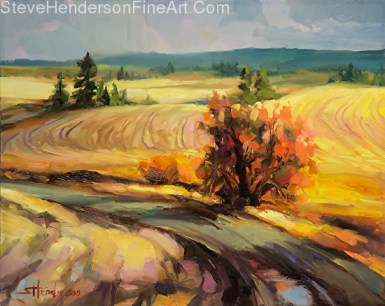
When we allow our kids to browse without constantly looking over their shoulder, sometimes they’ll read about flowers, and sometimes they’ll read about the birds and the bees. Field of Dreams, original oil painting by Steve Henderson.

And generally what they chose was really really bad — not because it had to do with everything you wanted to know about pistils and stamens — but because it was sanitized literature, custom created for the conservative, religious, not particularly literary-minded household concerned that every story have a moral, uplifting, teachable message as opposed to a compelling, interesting, provocative plot.

Reading was a necessary evil, its primary purpose to direct the child to a certain way of thinking. How very, very banal.  And how very, very unsurprising that many of these children grew up to — like their parents — not read much.

Caving in to Peer Pressure

I regret to say that, for a brief period of time, we subconsciously allowed this stern, inflexible attitude to influence our own, and actually forbade one daughter to read the same emerging author of horror I had read a generation earlier. At 13, she was the same age as I was when I read the books. I don’t know what I was thinking.

(“You worried needlessly,” she told me later. “I snuck them into the house and read them anyway, and quite frankly, he was so boring that I gave up after the first 50 pages.” Funny. That’s the same experience I had.)

Quite fortunately, we escaped the harsh bonds of literary — and lifestyle — asceticism — and subsequent children read vampire and zombie tomes to their heart’s content, my only concern being that the books themselves were so shallow and market-driven that they would damage the reader’s intellect. But they emerged unscathed, and still reading.

What should your child be reading?

Well, what are they interested in?

Thank You

Thank you for joining me at This Woman Writes, where I address homeschooling and family on Thursdays.

Learning to write well involves writing a lot, period. Grammar Despair addresses common issues that plague even the most well-read writers. Paperback and digital at amazon.com.

As a voracious reader who loves to write, I watched many, many homeschooling families struggle as much with teaching their child to write as they did “encouraging” them to read, and the problem was the same: they were micromanaging, subjecting the poor kid to intellect-numbing workbooks that taught writing by forcing the child to answer insipid questions, along the lines of, “Write three sentences about the scariest dream you’ve ever had.”

Rarely was the child encouraged to write what he felt like. It’s not as if the child will be a failure in life if he writes about aliens in the grocery store. The important thing is 1) that he’s writing and 2) that he’s finding it’s not so bad after all.

My book, Grammar Despair, is a skinny little tome that packs a lot in a few pages, addressing some of the major “issues” people have when they write: from whether to use there, they’re or their to how, and why, to use paragraphs. Why not add it to the jumble of books in your house?

Oh, and speaking of reading, if you’re a Christian, or a seeker of truth, I encourage you to visit me at my sister blog, Commonsense Christianity, published at BeliefNet. In the same way we strove to live peer-pressure free within the homeschooling community, we seek to live in line with Christ’s sayings, not the latest fad or fetish of pop culture Christianity.

Recent posts include

Missional. Intentional. Authentic: Meaningless (You hear these terms in church a lot, and while they sound like they mean something, they really don’t.)

The U.S. Is not a Christian Country. And It Never Was. (Mixing patriotism in with faith — while it sounds harmless — isn’t a good idea. The word “idolatry” comes to play anytime we take the worship we owe to God, and give it anyplace else.)

God. God? GOD! Are You There? (Admit it: sometimes you feel as if God is paying attention to everyone but you.)

Salvation Is Free. Our Time Is not (Any time you say “No,” top someone, they’ll try to make you feel that you are in the wrong. It’s okay to tell your pastor, the elder, the deaconess board: “No. I don’t have time to do this. But thank you for asking.”)

Posted in Art, blogging, books, children, Christian, Culture, Current Events, Daily Life, Education, Encouragement, Faith, Family, grandparenting, Growth, home, homeschooling, inspirational, instruction, Life, Lifestyle, Motherhood, News, Parenting, school, self-improvement, teaching, Uncategorized | Tagged , , , , | 2 Comments

Recipe: Pancakes

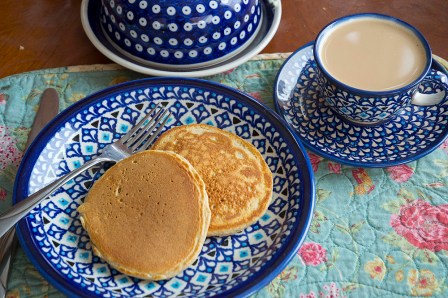
Pancakes are fast, easy, nutritious, and popular with all ages. Photo credit Steve Henderson Fine Art.

Pancakes are pretty much the fastest food on the planet to make — and that’s without a mix. If you’ve got the basics in your kitchen — flour, sugar, baking powder, salt, oil, eggs — you can whip together a breakfast, lunch, or dinner of this easy, pleasing food.

For years I visited a friend who made pancakes from a mix and they tasted like it: dull, insipid, processed, palatable only with the copious addition of syrup (it was fake) and margarine (even fakier). I spent time with my friend not for her food, but her company.

In later years, she experimented with a pancake mix that she put together from ingredients on hand, but this didn’t last long because life got busy and she didn’t have energy to devote to making the mix once it ran out. So we were back to the bag of insipid.

But seriously, making pancakes from scratch is so fast, and so easy, that you don’t have to buy, or make, a mix. If you’re not used to spending time in your kitchen, the first few efforts will take longer, but with practice, you’ll have the batter ready to go in five minutes flat.

Pancakes — Makes 12 pancakes, 4 to 5 inches diameter. The more whole wheat flour you use, the more filling the pancakes, and the fewer that people need to eat. This saves both money and calories.

Learning a new skill is something you can tackle at any age, and children are not the only people with functioning brain cells. Into the Surf, original painting by Steve Henderson, sold; licensed open edition print at Great Big Canvas.

We serve pancakes with an assortment of toppings, from organic maple syrup, which we get at Costco (what am I saying? We get pretty much everything from Costco, unless it grows in our garden or squirts from the udder of a goat); to peanut butter, honey, and homemade jam; to our naughty little indulgence, Nutella.

Ingredients:

1 cup all purpose flour

1 cup whole wheat flour (you can use all whole wheat flour, or 2/3 whole wheat flour; you can also use all white flour, but why not incorporate whole grains, with their higher nutritive value, into your diet? This is a painless way of doing so)

1/3 cup sugar (you can use less; I like the sweet. Just don’t eliminate the sugar entirely — it helps with the final texture and color)

2 teaspoons baking powder (go for aluminum-free)

1 teaspoon baking soda

1/2 teaspoon salt

2 eggs

1 Tablespoon vanilla (the real stuff is an investment, but it lasts a long time)

7/8 cup milk

1 Tablespoon lemon juice

3 Tablespoons oil or melted butter

Sift together the flours, sugar, baking powder, baking soda, and salt. (If you don’t have a sifter, this is what mine looks like; it’s a handy tool to have around for baking quick bread items like pancakes, muffins, and tea breads. Like many good tools, it does basically one thing, but it does it well.)

Don’t wait until the top of the pancake is covered with burst, dry bubbles before you flip. Look at the color of the bottom, and flip when it’s toasty brown. Photo courtesy Steve Henderson Fine Art.

In another bowl, whisk together the eggs, vanilla, milk, lemon juice, and butter.

Pour the liquid ingredients into the dry ingredients and stir quickly but not violently. The batter will be a little lumpy, but all the dry ingredients will be incorporated into the wet.

As far as texture, you’re looking for a pleasing blend between thick and thin — you don’t want the batter to look like heavy cream, and yet you don’t want it as thick as cookie dough. There is no exact “right” texture — if your pancakes seem dry, add more liquid; if they’re too flimsy and wet, add more flour. Pretty much anything you make will be edible, and if it’s really bad and you own a dog or chickens, then you won’t be wasting any “failures.”

Heat a griddle to high (mine says 455 degrees) or a nonstick skillet over medium high heat until a few drops of water skitter over the surface. Even when I use a non-stick surface, I spray it the first time with cooking spray or rub the cooking surface with a stick of butter. Often, I do this with every batch, as this treatment produces the mottled surface that I, personally, like so much.

Spoon the batter onto the pan with a large serving spoon and let the batter naturally spread itself out. My griddle (it looks like this) fits 5 pancakes in an array of 2/2/1; I could fit six across like the six on a dice, but it’s easier to flip the pancakes with five.

Many pancake recipes tell you to cook the pancakes until they are bubbly across the top and all the bubbles have burst. I have found that this is too long, and the top dries too much, and the bottoms are too cooked. I wait until a few bubbles have formed but the top is still moist, and the bottom is a medium, pleasing brown. Flip the pancakes ONCE — not over and over again as Eldest Supreme and a friend did one memorable weekend in their teenaged years — and let the bottoms cook until they are light brown. Kick up the heat if it seems to be taking too long; lower the heat if your breakfast is burning.

Fast, easy, cheap, nutritious, tasty — pancakes are a poor man’s food that make us all feel rich and decadent indeed. Enjoy them at the table, with a cup of tea and good company, and be grateful that you are full, warm, safe, and satisfied.

Thank You

Thank you for joining me at This Woman Writes, where I share a simple recipes on Tuesdays.

Saving money, writing better, learning art — I can direct you to three good resources in these areas.

You know, the more that you know how to do for yourself, the better you will live — economically and mentally. Don’t let anyone convince you that you’re too old to learn a skill; most of us are over the age of 5, which is the conventional, mythical age by which we are supposed to begin piano lessons, and most of us can manage to become competent in areas where we have an interest and desire to learn.

My book, Live Happily on Less, is a series of easygoing essays that show you where you can make simple, sustainable changes in your lifestyle, so the money you do make stretches further. Give it a try.

If writing is something you wish you were better at, you don’t have to enroll in a college course. Just start reading good books, and writing as much as you can. Another book of mine, Grammar Despair, addresses the common challenges that many of us face and throw our hands up in . . .  despair over. There’s no reason to do this.

Many people have secretly longed to learn art, but have given up on thinking they could ever achieve this desire. The Norwegian Artist has created a digital workshop DVD, Step by Step Watercolor Success, that is geared to the beginning and intermediate art student; with the PDF drawing sheets you receive when you  e-mail us and ask, you don’t even have to know how to draw to create a painting for your wall.

If you’ve got a desire to learn something, go for it. You’re the only one who can make it happen.

Posted in Art, blogging, cooking, Culture, Current Events, Daily Life, dinner idea, diy, Family, Food, frugal living, health, home, homesteading, instruction, Life, Lifestyle, News, Personal, Random, recipe, simple living, Uncategorized | Tagged , , , , | Leave a comment

Something for Everyone

And if there were a real mouse in the house, how big would its stocking be? This is one of those things that Santa knows. Something for Everyone, original oil painting, signed limited edition print, and open edition poster at Steve Henderson Fine Art.

The story of the painting, Something for Everyone, by Steve Henderson of Steve Henderson Fine Art:

So often, they are forgotten – the dog and the cat – but not in Santa’s world. Within that capacious bag of dolls and blocks and books and toys there are treats for man’s best friend and for cats, who are generally happiest being their own best friends.

The dog being a dog, it focuses on one thing at a time, but the cat sniffs, and thinks, and tries to maintain some sense of dignity while it investigates its gift. Santa isn’t fooled. He takes a moment to play with his furry friend before placing the toy in the itty bitty stocking on the mantle.

The model dog, which has never been a model dog in one sense of the word, is named Roxy. For the first two years of her life, she was on daily probation, because she ran, jumped, barked, chewed, knocked into, pushed over, and made general nuisance of herself. Now going on 7, she is no longer on probation, but she still runs, jumps, barks, chews, knocks into people, pushes others over, and thinks that cats are play toys without strings.

The cat’s name is Studio, because we had an idea that he would be a charming addition to the Norwegian Artist’s studio and that he would, well, sit, in the chair and just enjoy being part of the room. This cat does not sit. He goes after anything that moves, and if he can’t bring it down, he will adhere to it with claws and teeth. When what he is adhering to is your leg, this gets a little disturbing.

But Santa loves all earth’s creatures, and he doesn’t forget Roxy, Studio, and all the other good doggies and nice kitties out there on Christmas Eve Night.

Something for Everyone is available through Steve Henderson Fine Art as an original oil painting, signed limited edition print, and open edition poster. Join Steve’s free weekly e-mail newsletter, Start Your Week with Steve.

Art of all types and price ranges is available at Steve Henderson Fine Art. If you are a manufacturer of products and would like Steve’s art on your puzzles, greeting cards, calendars, wall art, clothing, or any other product that needs fine artwork, contact Art Licensing, Steve’s licensing agents. You can also contact Steve Henderson Fine Art directly by e-mailing Carolyn@SteveHendersonFineArt.com.

Posted in Art, blogging, Christmas, Culture, Current Events, Daily Life, Encouragement, Family, holiday, home, Humor, inspirational, Life, Lifestyle, News, Personal, santa, simple living | Tagged , , , , | Leave a comment

The Simple Life: Adapt. Like a Frog. Or a Finch.

If you’re going to fuss about something, make it your hair, as opposed to the rigidity of your schedule. Figurative, art print at Steve Henderson Collections.

I’m really not supposed to be chatting with you right now.

If my schedule, the one I set up last night before the snowstorm, were in place, I would be 70 miles away at Costco, shopping. The monthly hunt and gather of food at the grocery store is one I plan with anticipation, not the least because Costco always features an array of samples. One week they had two kinds of chicken and chocolate chip cookies.

But, because there is fresh snow on the highways (I’m not going to say how much, or how little, because all of the people in Buffalo, New York will snort at my driving timidity), I am adjusting my schedule to accommodate life’s little inconveniences. That’s why I’m sitting here with you, talking about two kinds of chicken and chocolate chip cookies.

(I’m out of both, incidentally, which would have been taken care of if there were not an undisclosed amount of fresh snow on the highways. We will have to get by on salmon fillets and Snickerdoodles.)

A Life of Stress

One aspect of living in a highly materialistic, stress-inducing, performance-requiring culture is that we make lists, adhere to schedules, and run our life with a rigid efficiency that shows the world how organized and productive we are, as if we manufactured widgets or something.

The work world is not a kind, gentle place, and it is easy to let its attitude of rigidity and conformity spill out into our lives at home. Field of Dreams, art print at Steve Henderson Collections.

We’re not called an Industrial Society for nothing (and even though we’re technically post-Industrial, the lessons learned — that we run our lives like machines, not humans — are deeply ingrained), and many of us approach each day with the goal that we’re going to get things done, by golly, and a lot of them. We’ve got a list to check off.

But once you start down the road of the simple life, you quickly learn that life is not predictable, and you are not a machine. Snowstorms happen. People wander in and out of your existence, needing things. You wake up tired and lethargic. Costco becomes an errand for another day.

Life Happens

Within the world of work, rigidity is a way of life, and when the boss is a butt, there’s not much that we can do about it. But even within the confines of the cubicle, humanity happens, and while a manager may berate us for a lapse in perfection, we don’t have to accept their words, or their attitude, into our hearts.

We are not failures because of the unexpected turns and twists of life. We are human beings, living the life that we have been given, and when circumstances are different than what we thought they would be, the smartest thing to do — and as post-Industrialists we pride ourselves on being smart — is to stop, review the situation, and be willing to make changes that make sense for us and our day.

Adapt, or Find Another Pond

When you can, where you can, take time to smell the blossoms of spring. Blossom, art print at Steve Henderson Collections.

The animal world does this all the time, and you don’t have to believe in Evolution (I don’t) to see that the creatures that adapt, are the creatures that survive. If you’re a frog in a pond and the pond dries up, you either find another pond or learn how to live with less water, that is, if you want to remain alive. If you’re a human being and the electricity is out for God knows how long and your only means of cooking is an electric range, you’ll probably have sandwiches tonight as opposed to steaks. But it will still seem romantic because you’ll be eating by candlelight.

Living the simple life is a process, and part of the process is approaching each day with a creative, open attitude, treating problems like challenges and disappointments like puzzles. Once you recognize, and accept, that life down here isn’t perfect and changes to our schedule are going to happen, you can smile, even if you’re doing it through pain.

Thank You

Thank you for joining me at This Woman Writes, where I address financial health and simple living on Fridays. If you are seeking the simple life, I encourage you to look at my book, Live Happily on Less: 52 Ways to Renovate Your Life and Lifestyle.

If you’re a Christian, or interested in Christianity, please join me at my BeliefNet blog, Commonsense Christianity. Recent posts there include

God. God? GOD! Are You There?

Salvation Is Free. Our Time Is Not.

“God Helps Those Who Help Themselves.” Yuck.

Is It Okay to Talk to the Grave of Your Loved One?

Posted in Art, blogging, Culture, Current Events, Daily Life, Economy, Encouragement, Family, finances, home, inspirational, Life, Lifestyle, News, saving money, self-improvement, shopping, simple living | Tagged , , , , | 1 Comment

Recipe: Soft Bread Sticks

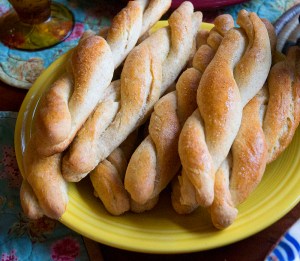
Soft bread sticks are relatively fast and easy, and they don’t last long! Photo courtesy Steve Henderson Fine Art.

Generally, we eat around the dining room table — with place mats, no less! — but sometimes, when I’m feeling wild and crazy and free, we set up the meal at the living room coffee table and sit on the floor. It feels so companionable and different (maybe it’s the absence of the place mats), and adds an extra sense of relaxation to the day.

For such an informal set up, you want an informal meal, like Soft Bread Sticks dipped in Shockingly Simple Spaghetti Sauce, with Easy Chai Tea on the side and a plate of sliced apples. This quick, simple meal is inexpensive and easy, leaving you time and energy to enjoy what matters most: time with your family.

Soft Bread Sticks — Makes 24 bread sticks — you can halve the dough and refrigerate it, covered, for another day. Frequently, I shape the second half into a dozen rolls that I place in a greased, covered pan. Two hours before I want to bake them I take the pan out and let the rolls come back to room temperature; I then bake them, in the uncovered pan, at 375 degrees for 20 minutes, until lightly browned on top.

Ingredients:

2 cups warm water

1 Tablespoon active dry yeast

1/4 cup olive oil (you can use melted butter, or another type of oil — whatever you’ve got

Less time preparing food means that you have more time to enjoy it with the people you love. Afternoon Tea, original oil painting by Steve Henderson; licensed open edition print at Great Big Canvas.

on hand)

1/4 cup sugar 

2 teaspoons salt

5 – 7 cups flour (I used 3 cups whole wheat and 3 cups white all purpose flour)

I used a Kitchen Aid Stand Mixer to make this, but you can use a wooden spoon or hand mixer, and knead by hand. The Kitchen Aid — which was Tired of Being Youngest’s early graduation present — has revolutionized my baking life, and adds to the reason why I don’t want Tired of Being Youngest to move out and away!

Sprinkle the yeast over the water and let dissolve, or, if you’re using the Kitchen Aid, mix the yeast and water together on low. Add the oil, sugar, and salt and mix until the sugar and salt are dissolved.

One cup at a time, add the flour, stirring or mixing until fully incorporated. If you are mixing by hand, you’ll want to dump the dough out for hand kneading once the dough gets sticky and starts to pull away from the bowl — after 5 cups, say. Knead in the last 1/2 cup to 2 cups of flour, a little bit at a time. If you’re using the Kitchen Aid, add the flour one cup at a time until the dough cleans the side of the bowl and adheres to the hook; I used a low medium speed (4 or 5 out of 10), and mixed for 10 minutes or so.

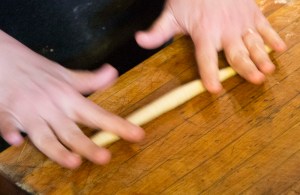
With your hands, roll each small piece into a long snake, 8 inches or so. Photo Courtesy Steve Henderson Fine Art.

Oil a large bowl and plop the kneaded dough into it. Turn it around to coat with the oil; cover the bowl with a towel or plastic bag, and let rise in a warm place for one hour.

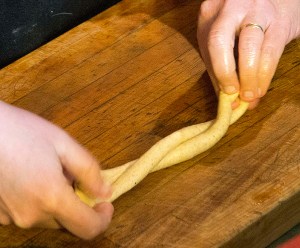
After an hour, punch the dough, turn it over, then pull it out of the bowl and cut it in half. Put one half back in the bowl, and cut the remaining half into 24 pieces. On a flat surface, roll each small piece into a long snake, shaping it with your hands. When you get two snakes, twist them together tightly and place on a greased cookie sheet. The first thing the twists will do is untwist, but they won’t completely come apart.

I fit 6 twists on a cookie sheet, but if you place them closer together, they just wind up touching and kissing one another. Shape 12 twists, then with the remaining half of dough, either shape 12 more twists, set the dough covered in the refrigerator for more breadsticks another day; or shape rolls in the fashion I describe above.

Let the twists rise, loosely covered with a dish towel or sheet of plastic wrap, for 20

Twist two snakes together to make one breadstick. Photo courtesy Steve Henderson Fine Art.

minutes.

Pre-heat the oven to 385 degrees. Once it’s heated, lightly brush the twists with an egg wash of an egg beaten with 1 tablespoon of water (you’ll probably have egg mixture left over; I give this to the cats). Sprinkle salt atop the breadsticks.

Bake for 12 – 15 minutes until lightly browned on both the top and the bottom. Brush the bread sticks with butter while they’re still hot. Or not.

Thank you

Thank you for joining me at This Woman Writes, where I talk about simple Recipes on Tuesdays.

If you read me every week, you know what’s coming next: yes, that’s right — when you learn how to cook for yourself, you save money. And if you’re interested in saving money, my book, Live Happily on Less, is an easy-to-read, easy-to-put-into-practice resource. Paperback and digital at Amazon.com.

Use the money you save to buy something fun and beautiful, like artwork from Steve Henderson Fine Art — originals and licensed open edition prints that make you happy and add color to your life.

Posted in Art, baking, blogging, cooking, Culture, Current Events, Daily Life, dinner idea, diy, Encouragement, Family, Food, frugal living, Growth, home, instruction, Life, Lifestyle, News, Random, recipe, saving money, teaching | Tagged , , , , | Leave a comment

An Unforeseen Encounter

All of Steve’s Santa paintings are available as original oil paintings, signed limited edition prints, or posters.

The Story of This Painting — An Unforeseen Encounter by Steve Henderson of Steve Henderson Fine Art:

Like all lovers of Christmas, Santa enjoys browsing the festive, holiday-decorated streets. On Christmas Eve night, when all shoppers are home in their beds, awaiting morning’s surprises, Santa stops in his tracks and enjoys a moment of looking at, and chuckling over, himself, and himself, and himself.

A skiing Santa. Hmm. That’s novel, and the sunglasses add a touch of panache and class. A nostalgic Santa, a wise Santa, a Santa with an outrageously bushy beard. It’s something to think about as he makes his rounds of the city, delivering gifts to children in the apartments overhead.

Subscribe to Start Your Week with Steve, the free weekly e-mail newsletter of Steve Henderson Fine Art.

Find Steve’s original paintings, licensed prints, or order customized note cards at Steve Henderson Fine Art.

Learn from Steve, through his Step by Step Watercolor Success digital workshop DVD. Distilling the information of a two-day workshop into a 70 minute DVD, Steve walks you, step by step, into creating a work of art for your wall, and learning a new skill that adds joy to your life.

Learn from Carolyn, through her books, Live Happily on Less and Grammar Despair: Quick simple solutions to problems like, “Do I Say Him and Me or He and I?”

Posted in Art, blogging, Christmas, Culture, Current Events, Daily Life, Encouragement, Family, holiday, Humor, Life, Lifestyle, News, Personal, santa, shopping | Tagged , , , , | Leave a comment

The Simple Life: Variety Isn’t Mandatory

The garden is a place of beauty in many ways; we enjoy walking through what we call, “The King’s Garden,” and watching the changes and growth from day to day. Promenade, original oil painting by Steve Henderson, sold; licensed open edition print at Great Big Canvas.

The Norwegian Artist is the simplest man on the planet to feed:

As long as the food tastes good, he eats it, and it doesn’t matter if it’s the same menu of yesterday, the day before, and the day before that. He reminds me a bit of our Siamese Cat, Mia, who given the choice between commercial cat food and baked halibut, chooses the cat food, every time.

Okay, so he’s not quite on the level of the cat, but the lack of fussiness in a family diner is a relief to the cook, who 1) sometimes doesn’t have a lot of time to come up with creative alternatives and 2) has a LOT of potatoes. One of the fastest, easiest, tastiest dishes I rely upon is Yukon Gold French Fries, with Kale That’s Worth Eating and either Simple Breaded Chicken or baked salmon on the side.

It Was Good the First Time

From the Norwegian’s standpoint, these dishes were delicious the first time he ate them, and subsequent appearances do not diminish the quality. Like me, he knows that we have boxes of organic potatoes we grew last year in the garden; a freezer full of wild Alaskan salmon caught by our Son and Heir; and a stand of brave, valiant, still living kale plants. When I make this meal, it is essentially free, and that means something to both of us.

“What would be the sense of buying food when we already have food — very good, organic food that would cost a lot in the stores — in our freezer and on our land?”  The Norwegian reasons. I really, really like this man.

Variety Is One, Optional, Aspect of Life

Be creative in how you approach variety — you can have the same item, or person, presented in many different ways. An Unforeseen Encounter, original oil painting, signed limited edition print, and poster by Steve Henderson.

Well, Variety Is the Spice of Life, they say. No, I’ll stay with my Norwegian, and the potatoes, while they’re abundant. As with many things that “they” say, it’s clever and all, and I can’t help wondering if it weren’t coined by advertisers out to sell us something. In the spirit of it, however, we do shake up the taters on the table:

Some days I sprinkle turmeric, hot pepper, and garam masala on the potatoes. Other days I serve them with a simple sauce. Still others I toss them in with the kale, a whole lot of exotic spices like cinnamon and green cardamom and coriander, and create a jumble. Same ingredients, different format, still free.

We’re using what we’ve got, you see, which is a basic principle of living simply and saving money, two concepts that can go hand in hand if we let them. In exchange for a radically different meal each night, we’re staying out of the grocery store, using our own storage centers as our primary place to shop. It’s not such an odd concept, and for most of history, in many cultures, it was — and still is, in some places — a way of life.

Good Food Is Good Food

Good food is still good food, even if you’ve experienced this menu before. Indeed, many people make a regular diet of boxed orange pasta product and hamburger-resembling-concoctions tucked into cardboard boxes. Day after day after day, and nobody finds that strange.

Seek simplicity and beauty in your life. They pay rich dividends. Light in the Forest, original oil painting by Steve Henderson.

As with any aspect of simple living, you make a game out of it, determining what small change you will make tonight to make the potatoes different somehow, or the kale dressed in a slightly different little black dress. Switching out the meat — from chicken to salmon to breaded burger — is often radical enough.

And as the weeks wear on and the supply of potatoes decreases, we pull out the seed catalogs and plan next spring’s grocery list, recognizing that, in a short time, potatoes and kale will be replaced by lettuce, radishes, and spinach, which we will enjoy until later summer, when zucchini and tomatoes and peppers grab center stage. And we’ll still be eating well, spending remarkably little money.

Such is the simple life. It’s worth pursuing.

Thank You

Thank you for joining me at This Woman Writes, where I address the Simple Life and Financial Freedom on Fridays. You can find my Recipes column on Tuesdays.

You know, when you save money in one place, you can enjoy it in another, say, with a piece of original or licensed fine art from my Norwegian Artist. Whatever it is that you want, you can frequently get it if you set funds aside by not spending them elsewhere (In the case of the Norwegian’s original art, we set up interest-free payment plans.)

I talk about living well, simply, in my book, Live Happily on Less, a series of easygoing essays that encourage you to make small, simple, sustainable changes in your lifestyle, so that you can make the most of what you have.

Posted in Art, blogging, cooking, Culture, Current Events, Daily Life, dinner idea, Economy, Encouragement, Family, finances, Food, frugal living, gardening, Green, Growth, home, homesteading, inspirational, Life, Lifestyle, money, News, Personal, Random, saving money, self-improvement, success, Uncategorized | Tagged , , , , | Leave a comment

We Never Could Afford Piano Lessons

It’s not such an odd thing for ordinary people to want to be happy. But in a world where greedy, powerful people snatch more than they need, the pursuit of happiness is something we have to be insistent about. Golden Opportunity, original oil painting by Steve Henderson; licensed open edition print at Great Big Canvas.

Some things in life we consider inviolable rights: life, liberty, and the pursuit of happiness immediately come to mind, but this is because I have a rudimentary familiarity with the U.S. Declaration of Independence. Just because the words are written on paper, and represent freedoms all people should enjoy, doesn’t mean that we will.

Which, we are beginning to see, is becoming a new reality. Or, given the depravity of mankind in all places and all seasons, perhaps always was the reality. We were just a bit too asleep to notice.

But on a more domestic level, and in many families, especially homeschooling families, and even more especially religious homeschooling families, piano lessons are an inviolable right of childhood. Now whether they contribute to the pursuit of happiness on the part of the child taking them is questionable, but it makes the parents feel better.

When our own brood of four was younger, we felt the pressure to conform, and set about securing lessons for Eldest Supreme, who was 12 at the time and by all accounts was far too old to begin learning, that is, if she were seeking a career as a concert pianist.

She wasn’t. She just, sort of, wanted to play the piano.

Mortgage-Free, First

Because we were raising a family of six on one modest income, and because our primary goal was to pay for our house as we built it so that we wouldn’t suffer a mortgage, we didn’t have a lot of expendable income for piano lessons, for one child, much less four. But we managed for a year, and Eldest Supreme practiced an hour a day and progressed quickly beyond elementary tunes to moderately difficult classical pieces (you don’t have to start at 5 to learn a skill, you know).

This is the way we framed our choice: spend our money on ensuring that we owed nobody, anything, or do what everyone else around us was doing and just spend the money, period. Sophie and Rose, original oil painting by Steve Henderson; licensed open edition print at Great Big Canvas.

And then, after that successful year, she and we decided that this wasn’t her passion, and that it would be best for all if we went on to something else. Children Numbers 2 and 3 weren’t remotely interested in music, and Tired of Being Youngest, though she banged about for hours on the keyboard, was, at five, too young.

The Voices That Surround Us

Ah, but according to the people who  gently apply pressure to everyone else’s lives, that five-year-old should be in lessons, and many of the very young people in the church we attended at that time did take lessons, conveniently, from the pastor’s wife. Every six weeks or so, we in the congregation heard a special, picked out on a few fingers, of a hymn — because this is pretty much all that a five-year-old can do, unless he or she is a prodigy. And that’s okay.

But Tired of Being Youngest kept slamming away at the keys, making music to her own ears, and we let her play, in both senses of the word.

As she grew older, she recognized what we all knew — that she was slamming away on the keys and making a noise that wasn’t necessarily beautiful — and decided that she wanted to do more. But she didn’t want lessons. Instead, she learned the rudiments of how to read notes from me (because I, like so many people, took lessons as a child), and she picked the brains of her friends who had taken lessons since they were five.

Autodidactic Learning

It takes some observation on our part, but children naturally gravitate toward things that interest them. Lilac Festival, original oil painting by Steve Henderson.

And she scoured the Internet — tracking down free musical scores, listening to how the piece was supposed to sound, and learning more about reading music by applying what she heard to what her fingers did. She skipped the hymns and went straight for the contemporary pop music that meant something to her, and in a rapid space of time, she advanced until she began to sound like her piano-playing friends.

Now, at 17, she plays beautifully — not at the level of a concert pianist, but in all honesty, neither do most of her peers — and she has jumped from pop music to classical and back to pop — still no hymns. Her disinterest in them must be genetic.

Eldest Supreme, College Girl, and the Son and Heir found interests outside of music — weight training, woodcarving, two-dimensional visual art, interior decorating — all of which they primarily learned autodidactically, which is one of the reasons we homeschooled them. All four progeny are very good at their chosen interests, and they continue getting better.

Customize Lessons to Your Child’s Interests

This is not to say that piano lessons are bad. They’re not. They’re just not mandatory.

Not all children are interested in music, in the same way that not all people think three-dimensionally and can carve animals out of wood, or not all people create customized weight lifting schedules for themselves, based upon extensive research.

Do not allow yourself to be pressured into providing lessons for your child that do not fit their interests and are difficult for you to afford — just because everybody else is doing so. Lessons — in music, art, dance, writing, athletics — are a beautiful opportunity, but they are a precious one. Choose wisely.

Thank You

Thank you for joining me at This Woman Writes, where I address Homeschooling on Thursdays.

Every day, there are new and exciting ways to learn the things in which we are interested. Step by Step Watercolor Success digital workshop by Steve Henderson.

If your older child (13-plus), and/ or you, are interested in art, I encourage you to look at my Norwegian Artist, Steve Henderson’s, digital watercolor workshop, Step by Step Watercolor Success available at Amazon.com and through our website, Steve Henderson Fine Art.

If you, and/or your child, are interested in writing and want to quickly tackle the basic problems that plague many of us, take a look at my book, Grammar Despair: Quick, simple solutions to problems like, “Do I say him and me or he and I?”

If you, like us, live on a moderate income because you have chosen to devote your time and energy to educating your brood, consider my book, Live Happily on Less, a series of easygoing essays drawn from our own background of living well on little. We own our home — mortgage free — and the land that it sits on.

Posted in Art, art education, blogging, children, Christian, Culture, Current Events, Daily Life, Education, Encouragement, Family, finances, frugal living, home, homeschooling, inspirational, Life, Lifestyle, Motherhood, News, Parenting, Personal, Random, saving money, school, self-improvement, success, teaching, Uncategorized | Tagged , , , , | Leave a comment

Do Christians Have a Message Worth Hearing?

The Norwegian Artist has bicycled over many, many miles of road. Highland Road, original oil painting by Steve Henderson; licensed open edition print at Light in the Box.

In my Norwegian Artist’s younger years, he bicycled around a bit — from Alaska to Argentina, through Central America (for the geographically challenged, there is no ocean separating North and South America), then after a flight across the Caribbean to Florida, he and a buddy wended their way back to Oregon by heading north to New York, then westward ho.

But at some point, two small town boys found themselves in the midst of New York City, in a rough section of town, and given the option to purchase some recreational street drugs.

“No thanks,” they replied with youthful ardor. “We have something better than that.”

The dealer stopped and looked them in the eye. “Yeah, I know all about that. You got Jesus, right?” and then he moved on.

That encounter non-plussed the Norwegian, who later tells it:

How We Say It Matters

“That man taught me something I never forgot: obviously, he’d heard about Jesus many many times before, but not in a way that meant anything. He was actually fairly polite.

Meaningful interaction involves time and interest in one another. Tea for Two, original painting by Steve Henderson; signed limited edition print, and poster.

“And I realized how often we just say things — trite sentences — and feel like that is enough. It’s as if once we say something — no matter how we say something — that we’re off the hook somehow, and whether or not the person listening accepts our message, it’s not our fault.”

By the time the Norwegian Artist and I met, seven years later, the bicyclist of youthful ardor was a man of thought and perspective, and he could read every emotion on my face when a zealous college evangelist accosted me in a corner and proclaimed,

“Believe in Jesus NOW or burn for eternity!”

The Norwegian Artist and I started out as friends, companions who walked miles each evening after classes, talking about everything: life, God, Jesus, purpose, and eternity along with literature, good food, contemporary music, and cat people versus dog people. He took time to answer my questions, and when he didn’t know an answer, he readily admitted it. Life is full of mysteries that we will never comprehend on this side of the curtain.

Good Decisions Take Time to Make

The result of these hours of talking and getting to know one another was, in addition to our falling in love and marrying (Yay!), my becoming a Christian, not only because of the time the Norwegian Artist took to talk and truly be my friend, but also despite what the shouting evangelist he rescued me from did.

Many Christians are familiar with, and cowed by, The Great Commission, a term not in the Bible used to describe Matthew 28: 19, in which the risen Christ instructs His disciples,

“Therefore go and make disciples of all nations, baptizing them in the name of the Father and of the Son and of the Holy Spirit, and teaching them to obey everything I have commanded you.”

For too many Christians, the interpretation of this verse involves standing on busy street corners, handing out tracts; walking up to total strangers and saying, “I’d like to tell you about Jesus”; or randomly dropping phrases like, “It’s a God Thing,” or “Thank you, Jesus!” into informal conversations.

Can We Stop Bringing up the “Comfort Zone” Already?

When people express reluctance to participate in behavior that is distasteful, embarrassing, or awkward, they are told, “Jesus wants you to get out of your comfort zone!”

What is so very objectionable about fitting into our surroundings, and feeling comfortable walking the path that we are on? Catching the Breeze, original oil painting by Steve Henderson, sold. Licensed open edition print at Great Big Canvas.

But actually, what Jesus wants is to do the will of His Father (John 4: 34), and the will of the Father is that “all men to be saved and to come to a knowledge of the truth.” (2 Timothy 2: 4).

Commonsense tells us that when we accost people, provoke people, or only interact with people because we want them to hear our words but are not particularly interested in making them a part of our lives, then our message is shallow, distant, and uninspiring.

Those last three adjectives definitely don’t describe the good news that Jesus brought to us, and wants us to bring to others:

God loves us. Crazy, insanely loves us. We do not have to undergo a series of intricately complicated ablutions to secure that love; we already have it. We just have to reach out and grab it, and we don’t even have to reach that far, because His hand is caressing our face.

That’s an amazing message.

As Christians, it’s worth taking time to 1) meditate upon the meaning of the message ourselves and 2) find a means of conveying it to others that is worth hearing.

Thank You

Thank you for joining me at This Woman Writes, where every Wednesday I write about Contempo Christianity. You can also find me at my BeliefNet Blog, Commonsense Christianity, where I post three times weekly.  Recent articles there include

Is It Okay to Talk to the Grave of Your Loved One? (So many of us do it, secretly, because we don’t want others to scold us for how wrong we’re being. But are we really wrong?)

Christians: It’s Time to Read Grown-up Books (As a society, we are becoming less and less literate, and some of what we feed our minds with . . . doesn’t feed our minds. We don’t need to read “Christian” books; we need to read good books.)

This Article Really Isn’t about Sex (It isn’t. It’s about grace, mercy, and money.)

Posted in Art, blogging, Christian, Culture, Current Events, Encouragement, Faith, Family, Growth, home, inspirational, Life, Lifestyle, marriage, News, Relationships, religion, spirituality, Uncategorized | Tagged , | 2 Comments

Recipe: Shockingly Simple Spaghetti Sauce

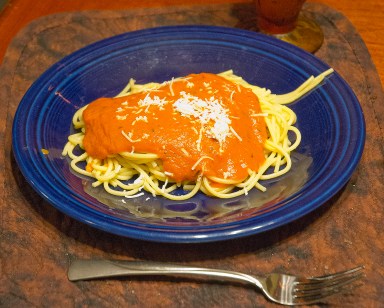
Other than opening a can of prepared stuff with unpronounceable ingredients, it doesn’t get much easier than this. Photo courtesy Steve Henderson Fine Art.

When I was a child, my dad was in charge of spaghetti. He began the process mid-morning Saturday and stayed in the kitchen, stirring and tasting and finessing, for hours, until the coup de grace at precisely 5 p.m., because that’s when all people of my generation (the Baby Boomers) ate dinner. If it was good enough for Beaver, it was good enough for us.

Years later, when I was a new bride, I asked Dad for his spaghetti sauce recipe, because just boiling the pasta was a challenge for me at that point. I wanted something of the family tradition to pass on, and I figured that since most of Dad’s recipe involved standing and stirring, even I could do that.

“Oh, it’s a couple cans of tomato sauce and some hamburger,” he said.

“That’s it? You spent HOURS in the kitchen.”

“I know,” he said with a smile. “It was peaceful and quiet. Everyone left me alone because they were afraid I would make them taste the sauce.”

Wisdom from a man with five children.

Today’s recipe, while it’s simple and doesn’t use many ingredients, is a step beyond two cans of tomato sauce and some hamburger, with the added bonus that you don’t have to spend from mid-morning until 5 p.m. in the kitchen, stirring (unless, of course, you want to). When I make it, I think of Dad, may you rest in peace, and I’ll see you again, someday. We’ll make something together in the kitchen.

Shockingly Simple Spaghetti Sauce — serves four, over pasta

My father was a world traveler, and while he didn’t deliver toys, he researched tropical diseases throughout the world. So, in his own way, he gave the world good gifts. The World Traveler by Steve Henderson — original painting, signed limited edition print, poster.

Ingredients:

3 Tablespoons olive oil

1 onion, chopped

1 head garlic, minced

1 15-ounce can tomato sauce (I buy Kirkland tomato sauce at Costco, but you can get it through Amazon.com)

Scant 1 cup water — fill the can that the tomato sauce was in half full, and stir to loosen the sauce from the sides of the can

2 Tablespoons sugar (I highly recommend Wholesome Sweeteners, organic and fair trade certified, from Costco, or Amazon.com)

1 Teaspoon salt

1 handful fresh herbs, minced, or 2 teaspoons dried herbs (I used a blend of sage, rosemary, and thyme from the kitchen garden)

Spaghetti, cooked, enough for 4 people

Saute the onions and garlic in the olive oil, over medium heat, for 10-15 minutes, or until the onions are limp. You may cook them to the point of being brown, or not, just stir now and then to keep everything from burning. This is a great time to wash the dishes, pause a moment to stir the onions, wash some more dishes, stir some more onions, and so on. If you’re not a clean as you go type person, this is a great way to become one and make friends out of the family members who are responsible for doing the dinner dishes.

Pour in the tomato sauce and water; add the sugar and salt; stir, and let cook for 3-5 minutes until hot. Stir in the herbs and let cook one minute more.

In a blender, or using an immersion blender, puree the sauce until smooth. Serve over spaghetti; sprinkle with cheese if desired. If you wish you can add cooked hamburger — my father’s secret ingredient — but the sauce tastes great without it. By the way, don’t leave out the sugar to make the sauce “healthier.” A small amount of sweetener balances out the acidity of the tomatoes and provides a pleasing taste.

Thank You

Thank you for joining me at This Woman Writes, where I write about good Recipes in my Tuesday column.

Good recipes, to me, use fresh or wholesome ingredients, don’t cost a lot, don’t take a lot of time, do not require a culinary degree to make, and taste delicious. I have always said, one of the first and easiest way to save money is to learn to cook, because this is 1) something pretty much anybody can do and 2) provides the most savings for the least amount of work.

If you’re interested in saving money, I encourage you to look at my book, Live Happily on Less, which is a series of easygoing essays about easygoing changes you can make, in order to do more with less. Paperback and digital at Amazon.com.

Posted in Art, blogging, Christmas, cooking, Culture, Current Events, Daily Life, dinner idea, diy, Encouragement, Family, Food, frugal living, home, instruction, Life, Lifestyle, News, Parenting, recipe, santa, saving money, travel, Uncategorized | Tagged , , , , , | Leave a comment